Rabindranath Tagore, lovingly remembered as Gurudev, stands as one of the greatest cultural figures not only in Indian history but in world civilization.
A towering intellectual and creative genius, Tagore was a poet, novelist, short story writer, playwright, essayist, philosopher, composer, painter, educator, and social reformer.
His life and work transcended boundaries of language, nation, religion, and ideology, offering a deeply humanistic vision rooted in freedom, beauty, and universal harmony.
He reshaped Bengali literature and music so profoundly that it is often divided into “pre-Tagore” and “post-Tagore” eras, such was the magnitude of his influence.
Tagore emerged during a time of intense political, cultural, and intellectual transformation in India. Colonial rule had disrupted traditional structures, yet it had also created a space for dialogue between Indian and Western thought.
From this crucible arose Tagore, a man who neither blindly rejected the West nor uncritically accepted it. Instead, he sought synthesis an integration of the spiritual depth of India with the scientific rationalism and humanism of the modern world.
His works conveyed the soul of India to the West while simultaneously urging India to open itself to global ideas. In 1913, Rabindranath Tagore became the first non-European to win the Nobel Prize in Literature, an achievement that catapulted him onto the global stage.
The Nobel Committee recognized him “because of his profoundly sensitive, fresh and beautiful verse,” particularly highlighting Gitanjali, a collection of poems that spoke of devotion, love, and the eternal bond between humanity and the divine.
This honor was not merely a personal achievement; it was a moment of cultural validation for colonized India, signaling that Indian thought and literature belonged at the heart of world civilization.
Yet Tagore was far more than a poet laureate of spiritual verse. He was a relentless critic of narrow nationalism, an advocate of individual freedom, a reformer of education, and a visionary who believed that creativity was the highest expression of human existence.
His founding of Santiniketan and later Visva-Bharati University embodied his belief that education should nurture the mind, body, and soul in harmony with nature.
His life was a continuous dialogue between tradition and modernity, individuality and community, nationalism and universalism.
Rabindranath Tagore lived a long and eventful life, witnessing the rise of Indian nationalism, the trauma of colonial oppression, the horrors of war, and the possibilities of a global human culture.
Through all this, he remained committed to truth, compassion, and artistic freedom. His legacy continues to shape literature, music, education, and philosophical thought across the world, making him not merely a figure of the past, but a guiding presence for the future.
Who Is Rabindranath Tagore?
Rabindranath Tagore was a Bengali polymath whose identity cannot be confined to a single discipline or role. Born on May 7, 1861, in Calcutta (now Kolkata), he belonged to a family that was deeply involved in intellectual, artistic, and social reform movements.
From a young age, Tagore exhibited extraordinary creative abilities, writing poems, plays, and essays that revealed a mature philosophical outlook even in adolescence.
At his core, Tagore was a seeker of truth and beauty. He believed that the purpose of life was the realization of harmony—between the individual and society, humanity and nature, the material and the spiritual.
This worldview permeated his writing, music, educational philosophy, and political thought. His poetry expressed intense emotional depth, spiritual longing, and a profound sense of joy in existence.
His novels and short stories explored social issues such as gender inequality, caste oppression, the conflict between tradition and modernity, and the psychological complexities of human relationships.
Tagore was also a composer of unparalleled influence. He created over 2,000 songs, known collectively as Rabindra Sangeet, which remain central to Bengali cultural life.
Remarkably, he also wrote the national anthems of two countries—India’s Jana Gana Mana and Bangladesh’s Amar Shonar Bangla—a testament to his enduring impact on national identity and collective emotion.
Internationally, Tagore was regarded as a cultural ambassador of India. He traveled extensively across Asia, Europe, and the Americas, engaging in dialogue with thinkers such as Albert Einstein, W.B. Yeats, Romain Rolland, and Ezra Pound.
Through lectures, essays, and personal interactions, he articulated a vision of global humanism rooted in mutual respect and creative exchange. Despite global fame, Tagore remained deeply connected to rural India.
He wrote extensively about village life, agrarian distress, and the moral responsibilities of the educated elite toward the poor. His life reflected a rare balance between cosmopolitanism and rootedness, making him a truly universal figure whose identity transcended geographical and cultural borders.
Rabindranath Tagore Family and Relationships
Rabindranath Tagore was born into the illustrious Tagore family, one of the most prominent and influential families in nineteenth-century Bengal.
His grandfather, Dwarkanath Tagore, was a pioneering entrepreneur and philanthropist who played a significant role in shaping modern Bengal. His father, Debendranath Tagore, was a philosopher and religious reformer associated with the Brahmo Samaj, a movement that sought to reform Hinduism by emphasizing monotheism, rationality, and ethical living.
The Tagore household was an extraordinary intellectual environment, filled with discussions on philosophy, literature, music, science, and politics.
Many members of the family were accomplished writers, musicians, artists, and social reformers. Growing up in such an atmosphere profoundly influenced Rabindranath’s intellectual development and artistic sensibility.
Tagore’s personal life was marked by deep emotional experiences, including profound loss. He married Mrinalini Devi in 1883, and the couple had five children. Tragically, Tagore lost his wife at a relatively young age, followed by the deaths of several of his children.
These personal tragedies deeply affected him and found poignant expression in his poetry, which often grapples with themes of loss, impermanence, and transcendence.
Despite these sorrows, Tagore maintained rich emotional and intellectual relationships throughout his life. He formed close friendships with fellow artists, writers, and thinkers, both in India and abroad. These relationships nurtured his creativity and expanded his philosophical horizons.
His correspondence reveals a deeply empathetic individual who valued emotional connection, intellectual exchange, and spiritual companionship.
Tagore’s family life, though marked by sorrow, strengthened his understanding of human suffering and compassion. It deepened his belief that love, creativity, and service to humanity were the only meaningful responses to the inevitability of loss and mortality.
Rabindranath Tagore Education
Rabindranath Tagore education was unconventional, and this unconventionality became the foundation of his later educational philosophy.
He was deeply dissatisfied with the rigid, mechanical system of formal schooling prevalent during his childhood. Tagore found classroom education stifling, rote-based, and disconnected from life and nature.
Much of his early learning took place at home, under the guidance of private tutors and through exposure to the rich intellectual life of his family.
He studied a wide range of subjects, including literature, history, philosophy, science, and music. He was particularly influenced by classical Sanskrit texts, Bengali folk traditions, and English literature.
At the age of seventeen, Tagore was sent to England to study law. However, he found the academic environment uninspiring and soon abandoned formal studies. Instead, he immersed himself in English literature, Western music, and European cultural life.
This period broadened his worldview and introduced him to Western intellectual traditions, which he later sought to integrate with Indian thought. Tagore believed that true education should cultivate creativity, critical thinking, emotional intelligence, and a deep connection with nature.
This belief led him to establish Santiniketan, an experimental school that rejected rigid curricula and emphasized learning through experience, art, and interaction with the natural world.
Rabindranath Tagore Career
Rabindranath Tagore career was extraordinarily diverse and prolific. He began writing at a very young age, and by his early twenties, he had already established himself as a significant literary figure in Bengal.
Over his lifetime, he produced an immense body of work, including poetry collections, novels, short stories, plays, essays, and songs. His poetry, particularly Gitanjali, brought him international acclaim and spiritual recognition.
His novels such as Gora, Ghare-Baire, and Chokher Bali explored social and psychological themes with remarkable depth. His short stories are considered masterpieces of realism and human insight, often portraying ordinary lives with profound emotional sensitivity.
In addition to literature, Tagore made lasting contributions to music. Rabindra Sangeet revolutionized Bengali music by blending classical Indian ragas with folk melodies and Western harmonies.
His songs continue to be sung across generations, shaping the emotional and cultural identity of Bengal. As an educator, Tagore’s greatest achievement was the establishment of Santiniketan and Visva-Bharati University.
These institutions embodied his belief in universal education, cultural exchange, and holistic learning. Students and scholars from around the world were invited to study there, creating a truly international academic environment.
Politically, Tagore was a moral voice rather than a conventional activist. He supported India’s freedom struggle but criticized violent nationalism and narrow patriotism.
His decision to renounce the knighthood bestowed upon him by the British in protest of the Jallianwala Bagh massacre was a powerful moral statement that resonated across India and beyond.
Rabindranath Tagore Physical Appearance
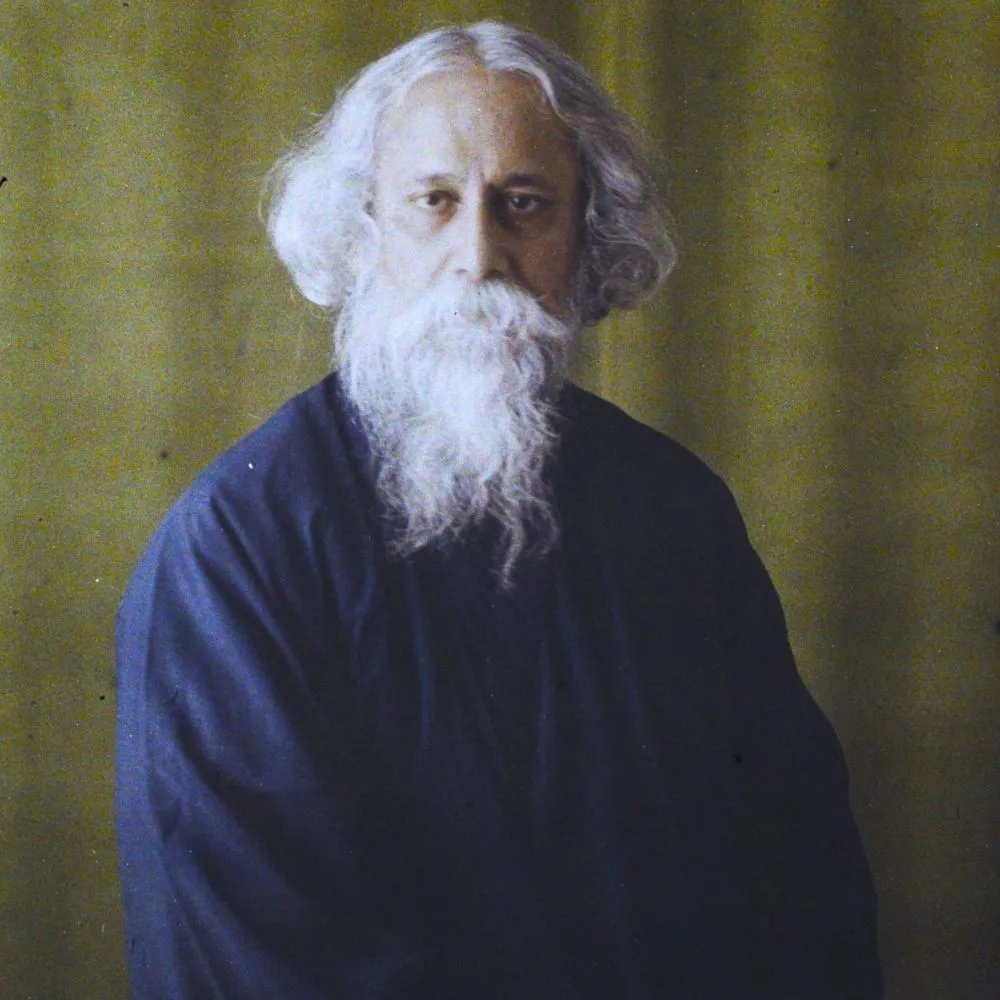
Rabindranath Tagore’s physical appearance became iconic, symbolizing wisdom, dignity, and spiritual depth. He was tall and slender, with a flowing white beard and long hair that gave him a sage-like presence in his later years.
His attire was simple and traditional, often consisting of loose robes that reflected his rejection of material excess. His expressive eyes conveyed gentleness, introspection, and intellectual curiosity.
As he aged, his appearance came to embody the image of a philosopher-poet, reinforcing the reverence with which people regarded him. Portraits and photographs of Tagore continue to evoke a sense of calm authority and timeless wisdom.
Rabindranath Tagore Net Worth
Assessing Rabindranath Tagore net worth in modern monetary terms is challenging, as his life was devoted not to wealth accumulation but to creative and intellectual pursuits.
Born into a wealthy family, he inherited estates and properties that provided financial stability. However, Tagore consistently used his resources to support educational initiatives, rural development, and artistic endeavors.
A significant portion of the money he earned from the Nobel Prize and his writings was invested in Santiniketan and Visva-Bharati University. He lived a relatively modest life, prioritizing cultural and educational contributions over personal luxury.
In terms of material wealth, his net worth would be considered moderate, but in terms of intellectual, cultural, and spiritual wealth, his legacy is immeasurable.
Rabindranath Tagore Conclusion
Rabindranath Tagore was not merely a literary genius or cultural icon; he was a visionary who reimagined the possibilities of human existence. His life was a testament to the power of creativity, compassion, and intellectual freedom.
Through his writings, music, and educational experiments, he offered a vision of a world united not by power or conquest, but by understanding, beauty, and shared humanity.
Tagore’s relevance has not diminished with time. In an era marked by division, materialism, and ideological conflict, his emphasis on universal brotherhood, harmony with nature, and the dignity of the individual remains profoundly meaningful.
He continues to inspire artists, thinkers, educators, and dreamers across the globe. Ultimately, Rabindranath Tagore greatest achievement lies not in awards or titles, but in his enduring ability to touch the human soul.
His words, melodies, and ideas continue to awaken minds and hearts, ensuring that Gurudev’s light will shine across generations and civilizations.
Personal Info
| Full Name | Rabindranath Tagore |
| Nick Name | • Bard of Bengal • Gurudev (called by Mahatma Gandhi) • Kavi Guru • Biswakabi |
| Date of Birth | 7 May 1861 (Tuesday) |
| Date of Death | 7 August 1941 |
| Place of Death | “Jorasanko mansion” (Jorasanko Thakur Bari), Calcutta, Bengal Presidency, British India (present-day Kolkata, West Bengal, India) |
| Age (at the time of death) | 80 Years |
| Death Cause | He died after a long spell of comatose. Note: Some sources claim that he may have died of prostate cancer. |
| Birthplace | “Jorasanko mansion” (Jorasanko Thakur Bari), Calcutta, Bengal Presidency, British India (present-day Kolkata, West Bengal, India) |
| Gender | Male |
| Currently, Live In | N/A |
| Nationality | British Indian |
| Religion | N/A |
| Ethnicity/Descent | N/A |
| Years Active | N/A |
| Profession | Polymath |
| Net Worth (approx.) | N/A |
| Hobbies | Watching Films and Dance |
| Favourite Clothing Brands | Calvin Klein and Levi Strauss & Co. |
| Favourite Gadgets | Smartphone, Digital Camera, Laptop, and Smart Watch |
| Food Habit | Non-Vegetarian |
| School/High School | He attended one of the Bengali-medium schools established by Iswar Chandra Vidyasagar and a number of English-speaking schools in Calcutta. After he turned 14, he was mostly home-tutored. He also attended a public school in Brighton, East Sussex, England. |
| College/University | University College, London |
| Education Qualification | He didn’t complete his formal education, and in 1940, he was awarded an honorary doctorate by Oxford University. |
Family & Relationship
| Parents | Mother:- Sarada Devi (homemaker) (died in 1875) Father:- Debendranath Tagore (15 May 1817 – 19 January 1905) (a Bengali philosopher and religious savant) |
| Siblings | Sister:- Name Not Known Brother:- Name Not Known |
| Marital Status | Widower |
| Affair/Girlfriend | Victoria Ocampo (Argentine writer and intellectual) |
| Wife/Spouse | Mrinalini Devi (born Bhabatarini) |
| Children | Son:- Rathindranath Tagore • Shamindranath Tagore Daughter:- Renuka Tagore (1890-1904) • Madhurilata Tagore also called ‘Bela’ (1886-1918) (first child and eldest daughter) • Meera Tagore also called ‘Atasi’ (1892-1962) (youngest daughter) |
Physical Appearances
| Height | in centimeters:- N/A in meters:- N/A in feet inches:- N/A |
| Weight | in kilograms:- N/A in pounds:- N/A |
| Figure Size | N/A |
| Eye Color | N/A |
| Hair Color | N/A |
| Tattoos | N/A |
Rabindranath Tagore Legacy
Rabindranath Tagore Social Media Profiles
If you want to follow her on social media profiles, then you can give her a follow-up below.
| N/A | |
| N/A | |
| N/A | |
| YouTube | N/A |
Check out the more below:
- Elvis Presley Wiki, Age, Net Worth, Feet, Height, Family & More
- Justin Bieber (Singer) Wiki, Age, Net Worth, Height, Family & More
- Amber Heard Wiki, Bio Age, Net Worth, Height, Daughter & More
- Ruth Righi Wiki, Bio, Parents, Age, Net Worth, Height, Born & More
- Kheris Rogers Wiki, Bio, Age, Height, Net Worth, Boyfriend & More